From the sprawling courtyards of Topkapı to the crystal staircases of Dolmabahçe and the serene gardens of Yıldız, Istanbul's imperial palaces tell the story of an empire across nine spectacular sites.
From the Byzantine days of Constantinople to the magnificent palaces built during the Ottoman dynasty, there is so much to explore at the dazzling historical palaces of Istanbul. Each one reveals a different era of imperial life — and most sit right on the water, offering some of the most beautiful views on the Bosphorus.
Topkapı Palace — A City Within a City
The biggest and most popular palace in Istanbul was built between 1466 and 1478 by Sultan Mehmet II on a hilltop dominating the Golden Horn to the north, the Sea of Marmara to the south, and the Bosphorus to the north-east. It was the political centre of the Ottoman Empire between the 15th and 19th centuries. Local people called it "Topkapı" — meaning "Gate of Cannons" — because of the huge cannons displayed outside its gates during the Conquest.
The palace became the largest in the world, a city within a city. Its surrounding walls were about 5 kilometres (3 miles) long. At its height, 4,000 people lived within its walls across an area of 700,000 m². The palace was opened to the public as a museum in 1924 by the order of Atatürk. Each sultan added a different section during 400 years of reign, creating a maze of courtyards, pavilions and gardens. Don't miss the Harem quarters, the Treasury with the 86-carat Spoonmaker's Diamond (Kaşıkçı Elması), and the magnificent palace kitchens.
Çırağan Palace
Built in 1856, Çırağan Palace is one of the last architectural works of the Ottoman period, designed by Nikoğos Balyan and built by Sarkis and Agop Balyan. Covering an area of 80,000 square metres, the building took four years to complete. The garden was damaged by a fire in 1910, and by 1980 the entire palace underwent restoration and was converted into a luxury hotel. The palace is made up of three sections — the main building, apartments and a harem — and remains one of the most beautiful pieces of architecture along the Bosphorus.
Dolmabahçe Palace
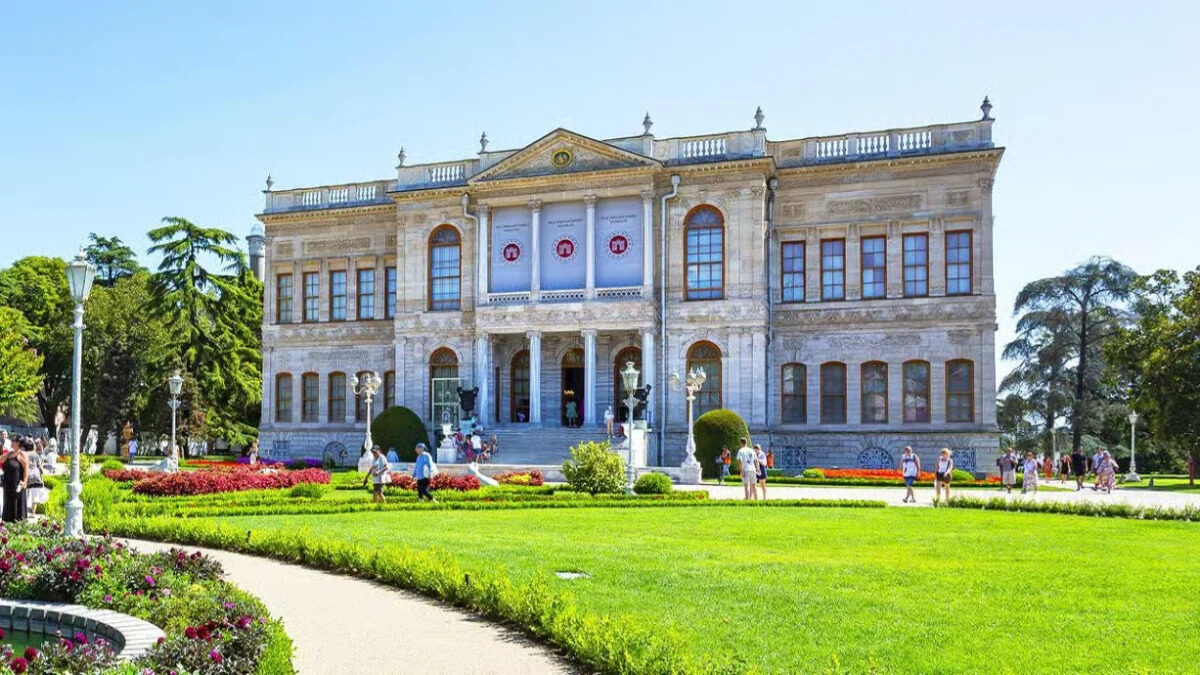
Completed in 1856 in the Beşiktaş district on the Bosphorus's European shores, Dolmabahçe was built on orders of Sultan Abdülmecid I and designed by the Balyan family. It was constructed on land reclaimed from the bay where the Ottoman fleet once moored — hence "Dolmabahçe," roughly meaning "filled-in garden."
The palace occupies 45,000 square metres and houses 285 rooms, 43 halls, 68 bathrooms and 6 hamams. Its interior was designed by a Frenchman named Sechen, who also designed the Paris Opera. The palace is home to the world's largest Baccarat and Bohemian-style crystal chandelier and is filled with Sèvres and Yıldız porcelain and Hereke rugs. The fourth sea-facing room — once the Muayede Hall, now the Hususi Apartment — is where Atatürk passed away, and is today a museum exhibiting his personal possessions.
Beylerbeyi Palace
As you cross the Bosphorus Bridge to the Anatolian side, one of the most eye-catching sights is Beylerbeyi Palace. Commissioned by Sultan Abdülaziz I and completed in 1865 by Sarkis Balyan and his brother Agop Balyan, its architecture blends traditional Turkish residential design with classical Baroque. The main building, with its gardens and pools, was used both as a summer palace and to host important foreign dignitaries. Frescoes depicting rough seas and maritime-themed decorations reflect Sultan Abdülaziz I's passion for the sea. There are also rooms decorated with Japanese and Chinese art.
Yıldız Palace
Yıldız Palace, the last architectural example of the Turkish Ottoman palace tradition, is located on the Yıldız hill in Beşiktaş. The site was used as a hunting place for sultans since the reign of Suleiman the Magnificent (1520–1566). The main construction began during the reign of Sultan Abdülhamid II (1876–1909) and comprised buildings for the sultan's private use, officials' quarters, repair shops, a theatre, museum and library.
The palace has an inner garden called "Hasbahçe" with a pool resembling a natural creek, dotted with small independent resort kiosks. Today it serves as a museum under the name "Directorate of the Museum of Yıldız Palace" since 1993. It is also home to the Yıldız Porcelain Factory, established in 1894, which today is a museum-factory producing both modern design items and reproductions of the Ottoman period.
Küçüksu Palace
Küçüksu Kasrı is a summer palace situated in the Küçüksu neighbourhood of Beykoz district on the Asian shore of the Bosphorus, between Anadoluhisarı and the Fatih Sultan Mehmet Bridge. Commissioned by Sultan Abdülmecid and designed by Garabet and Nikoğos Balyan in neo-Baroque style, it was completed in 1857. The rooms at the waterfront have two fireplaces each fashioned from colourful Italian marble, with crystal chandeliers from Bohemia and Hereke carpets. The palace gained fame internationally as a filming location for the James Bond movie "The World Is Not Enough" and the Bollywood hit "Ek Tha Tiger."
Ihlamur Pavilion
Located between Beşiktaş, Yıldız and Nişantaşı, Ihlamur Pavilion was built in 1849–1855 within a 24,724 m² woodland. It consists of the Ceremonial Kiosk — the main building with an impressive Baroque staircase — and the Maiyet Kiosk, used by the sultan's entourage. The Ceremonial Kiosk is open to visitors as a museum-palace; the Maiyet Kiosk operates as a winter cafeteria, while the garden areas serve as a summer cafeteria — making it a lush retreat in the heart of the city.
Aynalıkavak Pavilion — The Shipyard Palace
Known as "The Shipyard Palace," Aynalıkavak Pavilion is one of Istanbul's hidden architectural gems, located in the Hasköy region of Beyoğlu on the northern bank of the Golden Horn. It was named after mirrors gifted to Sultan Ahmed III and the poplar trees in its gardens. Originally constructed during the reign of Sultan Selim III, it is one of the rare illustrations of authentic Ottoman design untouched by European influence, topped with a magnificent dome and an elegant roof. The interior features a divan room, stained glass, silk-covered couches, and a poem by Sultan Selim III engraved on one of the walls. Today it serves as a Palace-museum and Turkish Music Research Centre.
Maslak Pavilion
Located on Büyükdere Street in Maslak, the Maslak Royal Lodges are set in a wooded park of 170,000 square metres and consist of the main Kasr-ı Hümâyün, the Mabeyn-i Hümâyün with its adjoining Conservatory, the Çadır Köşk and Paşalar Daire. Commanding a magnificent view over the Bosphorus, the kasırs are outstanding examples of late 19th-century Ottoman architecture. Restored to their original state using contemporary documents, memoirs and photographs, the complex and its landscaped National Sovereignty Park are now open to the public, with the Conservatory and Çadır Köşk serving as cafes.
Planning Your Palace Visits
Most palaces are closed on Mondays or Tuesdays. Dolmabahçe and Topkapı are the most visited and benefit from an early morning arrival. Combine Küçüksu and Beylerbeyi on the Asian shore in one day. Turquaz Travel can arrange private guided palace tours with skip-the-queue access — build your custom Istanbul itinerary here.
Frequently Asked Questions
Which Istanbul palace is most worth visiting?
Topkapı Palace is the most historically significant, while Dolmabahçe is the most opulent. Both are must-sees — plan a full day for Topkapı and 2–3 hours for Dolmabahçe.
Is Çırağan Palace open to visit?
Çırağan Palace operates today as the Çırağan Palace Kempinski Istanbul. Its exterior and gardens can be viewed; the interior is a luxury hotel.
Can I visit multiple palaces in one day?
Yes — Küçüksu and Beylerbeyi are both on the Asian shore and can be combined. On the European side, Topkapı and Dolmabahçe are about 5 km apart along the waterfront.
Plan Your Türkiye Trip With Local Experts
Licensed TÜRSAB agency — tours, transfers, visas and tailor-made itineraries across Türkiye.